










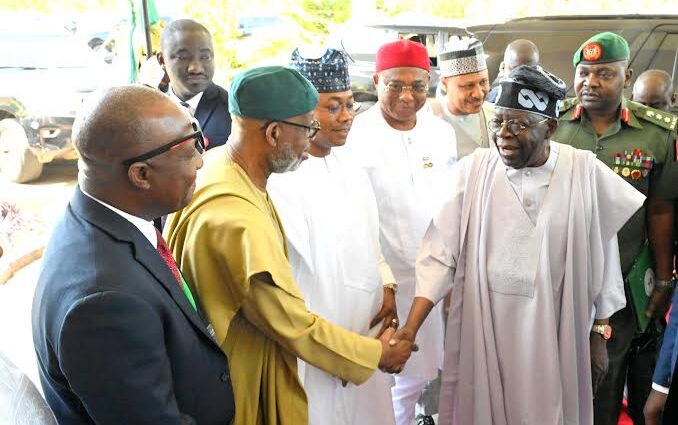
Nigerian Editors Sound Alarm on Media Collapse, Tinubu Urges Fairness and Pledges Economic Recovery
In a stark warning delivered at the State House in Abuja, the Nigerian Guild of Editors (NGE) has declared that the nation’s media industry is in severe financial distress, with many organizations teetering on the brink of collapse due to unsustainable operational costs.
A Plea for Survival
Presenting a rescue plan at the 21st All Editors Conference, NGE President Eze Anaba outlined a series of urgent proposals. The Guild is seeking a five- to ten-year corporate tax relief for media companies, VAT exemptions on essential inputs, and tax credits for corporations that advertise in verified Nigerian outlets. Furthermore, they have called for low-interest loan windows through the Bank of Industry and the Development Bank of Nigeria to support critical equipment upgrades and digital migration.
“The media today is distressed,” Anaba stated. “Many organisations simply cannot pay salaries, not because they are incompetent, but because the cost of production has become prohibitive.” He highlighted that the price of a single tonne of newsprint has skyrocketed to between N1.3 million and N1.4 million, a supply that lasts only a few days in a busy newsroom.
The Guild also proposed the creation of a Media Innovation Fund to bolster online platforms, data journalism, and multimedia storytelling. Anaba connected the survival of the press directly to the health of the nation’s democracy, issuing a powerful reminder: “When the press thrives, democracy breathes. When the press is stifled, democracy suffocates.”
Tinubu’s Call for Patriotic Reporting
In his address to the assembled editors, President Bola Tinubu acknowledged the media’s historic role as an instrument of national awakening but urged them to exercise their watchdog role with fairness and a sense of patriotism. While affirming the right to critique government policy, he cautioned that such criticism must not come at the expense of national unity or the country’s global image.
“Verification must be your anchor. Balance must be your principle,” the President advised. “Criticise government policy, but do so with knowledge and fairness. Let your aim be to help build, not destroy.”
Reflecting on the initial public outrage following his administration’s economic reforms, including foreign exchange liberalisation, Tinubu expressed optimism about Nigeria’s economic trajectory. “When I assumed office and removed the arbitrage to stop corruption and strengthen the economy, you all dealt with me,” he remarked. “But today, we should celebrate that progress is being made. The days of darkness are ending; the economy is on the path to improvement.”
In a significant move, President Tinubu gave his “endorsement” to the NGE’s proposals for industry support, signaling a potential lifeline for the struggling sector.
Press Freedom “Flourishing,” Says Information Minister
Supporting the President’s stance, the Minister of Information and National Orientation, Mohammed Idris, declared that press freedom is flourishing under the current administration. He reported that more than 1,000 radio and television stations are operating freely across the country without intimidation or censorship.
“This is not by coincidence, but by conviction. The President understands, from personal experience, that a free and vibrant media is essential to democracy,” Idris stated, noting that no media organisation has been shut down or sanctioned under Tinubu’s government.
A Warning Against Tribal Bias
Imo State Governor, Hope Uzodimma, delivering the keynote address, issued a stern warning against the infiltration of tribal bias into journalism. He cautioned editors that allowing tribalism to masquerade as journalism fundamentally undermines democracy.
“If the newsroom allows disinformation, rumour and tribalism masquerading as journalism, then electoral integrity is already compromised even before the vote is cast,” Uzodimma asserted. He challenged journalists to highlight what unites Nigerians rather than what divides them, emphasizing that “public confidence lives or dies in the narratives you control.”
Economic Optimism Amidst Global Hunger Warning
While President Tinubu projected confidence in Nigeria’s economic recovery, a sobering report from the United Nations presented a contrasting global picture. A joint publication by the Food and Agriculture Organisation (FAO) and the World Food Programme (WFP) classified Nigeria among 16 global hunger hotspots of “very high concern.”
The “Hunger Hotspots” report warned that millions could face famine between November 2025 and May 2026, driven by conflict, economic shocks, and extreme weather. The agencies appealed for renewed global attention and sustained investment in resilience, stressing that famine remains predictable and preventable with decisive government action.
This juxtaposition of national economic assurance and international food security concerns underscores the complex challenges facing Nigeria’s leadership and the critical role of a robust, financially viable media in navigating the public through these turbulent times.
All credit goes to the original article. For more information, read the source.