










Jigawa Tsangaya Reform: 96% Success Rate and the Future of Integrated Islamic Education in Nigeria
In a landmark achievement for educational reform in northern Nigeria, the Jigawa State Government has announced that 96% of participants in its Six-Month JISTEB/NBAIS Special Programme have successfully met all required standards and obtained nationally recognized certificates. This milestone represents a significant step forward in bridging the gap between traditional Islamic education and modern formal schooling—a challenge that has persisted for decades across the region.
Programme Overview: Bridging Two Worlds
The programme, implemented through the Jigawa State Tsangaya Education Board in collaboration with the National Board for Arabic and Islamic Studies (NBAIS), trained 150 Alarammas (traditional Quranic teachers) across study centres in Dutse, Hadejia, and Gumel. Participants were taught and examined in nine subjects, including English Language, Arabic, Islamic Studies, Mathematics, and Computer Studies, in a structured learning environment designed to integrate Islamic and conventional education.
Why This Matters: The Context of Tsangaya Education in Nigeria
Tsangaya schools, also known as traditional Quranic schools, have long been a cornerstone of Islamic education in northern Nigeria. However, they have historically operated outside the formal education system, leaving millions of children without access to basic literacy in English, numeracy, or science. This has created a cycle of limited economic opportunity and social marginalization. The Jigawa reform programme directly addresses this gap by providing a structured pathway for Tsangaya graduates to earn recognized qualifications without abandoning their Islamic educational roots.
Governor’s Response: A Vision for Sustainable Reform
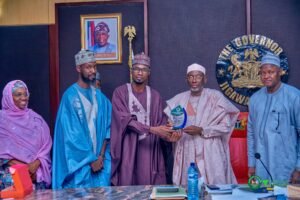
Speaking when the executive secretary of the Tsangaya Board presented the report during the monthly sector meeting, Governor Umar Namadi expressed profound satisfaction with the outcome, describing it as a groundbreaking achievement for the state’s education sector.
“Alhamdulillah, today we are truly very happy about this achievement recorded by our brothers who have completed this course and obtained certificates. The fact that about 96 percent of them met all the required standards is no small achievement,” the governor said.
He noted that the success of the programme demonstrates the untapped potential within the Tsangaya system when properly supported.
“Each of them has now acquired what is necessary to continue their education. Within just six months, they were taught and examined in English, Arabic, Islamic studies, and other subjects—nine in total—and they passed. This is a remarkable success.”
Overcoming Educational Barriers: The Remarkable Achievement of Non-Formal Learners
Governor Namadi further pointed out the importance of the achievement, particularly given the background of the participants.
“None of them had attended formal primary school, yet they were able to pass examinations equivalent to the secondary school level. This clearly shows that this programme is something we must continue,” he stated.
This point cannot be overstated. In conventional education systems, learners typically spend 6–9 years progressing from primary to secondary level. The fact that these 150 individuals—all of whom had only Quranic education—could achieve secondary-level competency in just six months speaks volumes about the cognitive foundations built by traditional Islamic pedagogy. It also challenges the assumption that Tsangaya students are ‘behind’ their peers; rather, they possess transferable skills in memorization, discipline, and analytical thinking that can be rapidly adapted to modern curricula.
Commitment to Expansion: A Model for Other States
Restating his administration’s commitment, the governor assured that the initiative would be sustained and expanded.
“Insha Allah, as a government, we will sustain this programme and build on it because it will bring us even greater benefits. It also demonstrates that if we continue with this initiative, it will serve as a strong safeguard for us in Jigawa State.”
Real-Life Impact: A Certificate That Changes Lives
Highlighting the real-life impact of the programme, Governor Namadi cited a practical example of its value.
“There was a participant who contested for a position that required a secondary school certificate. Initially, he did not have one but later remembered he had undergone this training. He retrieved his certificate, and it was accepted, enabling him to secure the position. This is a clear testimony to the importance of this programme.”
This anecdote illustrates a critical point: in Nigeria, the lack of a recognized certificate is often a greater barrier to opportunity than the lack of actual knowledge. By providing NBAIS-certified credentials, the programme unlocks doors to employment, further education, and civic participation that were previously closed to Tsangaya graduates.
Key Success Factors: What Made the Programme Work?
The report also highlighted key components that contributed to the programme’s success, including:
- Stakeholder engagement: Involving community leaders, Islamic scholars, and education officials from the outset ensured buy-in and cultural sensitivity.
- Rigorous screening processes: Participants were carefully selected to ensure they had the foundational Quranic knowledge necessary to benefit from the accelerated curriculum.
- Curriculum development: The curriculum was designed to integrate Islamic studies with core modern subjects, avoiding the perception that one system was being sacrificed for the other.
- Provision of accommodation and learning materials: Many participants came from rural areas; providing housing and textbooks removed logistical barriers to attendance.
- Performance-based incentives: Both participants and facilitators received rewards tied to outcomes, creating a culture of accountability and motivation.
Practical Example: How Other States Can Replicate This Model
States like Kano, Katsina, and Borno—which also have large Tsangaya populations—can learn from Jigawa’s approach. The key is not to replace Quranic education but to supplement it with structured, certified instruction in English, mathematics, and science. For instance, a similar programme in Kano could partner with local Islamic councils to identify motivated Alarammas, then provide intensive six-month bridging courses using the NBAIS curriculum. The cost per participant is relatively low when compared to building new schools, and the social return—in terms of reduced poverty and increased civic engagement—is substantial.
Conclusion: A Blueprint for Inclusive Education
Governor Namadi commended all stakeholders involved in the successful implementation of the initiative, including facilitators, coordinators, and the Tsangaya Education Board.
“I congratulate you all on this success you have achieved. This is a collective effort, and it shows what can be done when we work together with commitment and sincerity,” he said.
The Jigawa Tsangaya Reform Programme offers a powerful proof of concept: that traditional and modern education are not mutually exclusive, and that with the right support, even the most marginalized learners can achieve remarkable results. As Nigeria continues to grapple with out-of-school children and educational inequality, this model provides a scalable, culturally appropriate solution that deserves national attention.
All credit goes to the original article. For more information, read the: Source link