










APC Affirms Gov. Umar Namadi as Jigawa Governorship Candidate for 2027: A Deep Dive into the Consensus and Its Implications
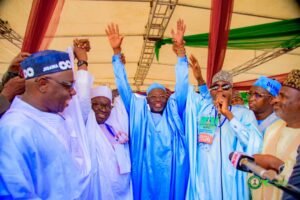
In a decisive and well-orchestrated political maneuver, the All Progressives Congress (APC) in Jigawa State has officially reaffirmed Governor Umar Namadi as its consensus governorship candidate for the 2027 general election. This early affirmation, occurring nearly two years before the polls, signals a strategic move to consolidate party unity, preempt internal dissent, and project an image of stability and continuity. For readers unfamiliar with Nigerian political dynamics, a ‘consensus candidate’ is one agreed upon by party stakeholders without a contested primary election—a process that can either foster unity or breed resentment if not handled transparently. In this case, the APC in Jigawa appears to have navigated this delicate process with notable success.
The Event: A Show of Strength and Unity
The affirmation ceremony took place on Saturday at the Dutse Township Stadium, a venue symbolic of the party’s grassroots reach. The gathering drew thousands of APC supporters from all 27 local government areas of Jigawa State, alongside a who’s who of the state’s political elite. Among the dignitaries present were former governors Barrister Ali Sa’ad Birnin Kudu and Alhaji Ibrahim Saminu Turaki, as well as Senator Ibrahim Hassan Hadejia, a former deputy governor and current deputy chief of staff to the president. The presence of Independent National Electoral Commission (INEC) officials and security agency representatives added a layer of procedural legitimacy to the event, underscoring the party’s commitment to following electoral guidelines.
Why This Matters: The Strategic Timing of the Affirmation
Political analysts often debate the wisdom of early endorsements. On one hand, they can galvanize support and allow the candidate to focus on governance rather than intra-party campaigning. On the other, they risk alienating other aspirants and creating a sense of inevitability that may suppress voter enthusiasm. In Jigawa, the APC’s decision to affirm Governor Namadi so early appears to be a calculated risk. By securing the party’s backing now, Namadi can dedicate his remaining term to delivering on his ‘Greater Jigawa’ agenda without the distraction of a contested primary. This is particularly important given the state’s developmental challenges, which include improving infrastructure, healthcare, and education.
Governor Namadi’s Response: A Call to Mobilization
In his address to the crowd, Governor Namadi expressed profound gratitude to party members and the people of Jigawa State. He framed the endorsement not as a personal victory but as a collective responsibility. “Alhamdulillah, we thank Almighty Allah for sparing our lives to witness this day today. I want to sincerely thank the people of Jigawa State, particularly members of our great party, the APC, for endorsing me today as the gubernatorial candidate for the 2027 general election,” he said.
Namadi emphasized that the affirmation was merely the first step in a longer political journey. He urged party members to begin full-scale mobilization to ensure victory for all APC candidates in 2027—from the presidency down to the State House of Assembly. This call to action is a classic political strategy: by linking his candidacy to the broader party ticket, Namadi aims to create a sense of shared destiny and collective effort. For practical context, this means that local party leaders are now expected to organize ward-level meetings, voter registration drives, and community outreach programs to build momentum.
The ‘Greater Jigawa’ Agenda: What It Means for Citizens
Governor Namadi reiterated that his administration’s ‘Greater Jigawa’ agenda remains on course. But what does this agenda entail for the average citizen? Based on his previous policy announcements, it includes:
- Infrastructure Development: Road construction, rural electrification, and water supply projects aimed at connecting remote communities.
- Agricultural Transformation: Support for farmers through improved access to fertilizers, irrigation schemes, and market linkages—critical in an agrarian state like Jigawa.
- Education and Healthcare: Upgrading schools and primary healthcare centers, with a focus on reducing maternal and child mortality rates.
- Youth Empowerment: Skills training programs and small business loans to combat unemployment.
For the ‘Greater Jigawa’ vision to resonate with voters, Namadi will need to demonstrate tangible progress in these areas before 2027. The early affirmation gives him a head start, but it also raises expectations.
The Consensus Process: A Model of Political Maturity?
Governor Namadi praised the consensus arrangement that led to his affirmation, describing it as “90 percent successful” and one of the most coordinated political consultations in the country. He credited former Governor Ali Sa’ad Birnin Kudu for leading the consultation and mobilization efforts alongside local government stakeholders. This level of intra-party harmony is rare in Nigerian politics, where primaries are often marred by violence, vote-buying, and legal disputes. The Jigawa APC’s approach offers a potential template for other states, though its success hinges on the willingness of all stakeholders to prioritize party unity over personal ambition.
Practical Example: How Consensus Works in Practice
To understand the consensus process, consider a hypothetical scenario: In a local government area, three party elders initially backed different aspirants. Through a series of closed-door meetings facilitated by former Governor Birnin Kudu, they agreed to support Namadi in exchange for commitments on resource allocation and appointments. This backroom bargaining, while opaque to the public, is often necessary to avoid a fractious primary. The key to its success is trust—both in the mediator and in the candidate’s willingness to honor promises.
Challenges Ahead: What Could Derail the Momentum?
Despite the show of unity, several challenges loom. First, the opposition parties—particularly the Peoples Democratic Party (PDP) and the New Nigeria Peoples Party (NNPP)—are likely to exploit any governance failures or internal APC rifts. Second, the economic climate in Nigeria, including inflation and fuel subsidy removal, could erode public goodwill. Third, the APC’s national leadership may face its own internal battles, which could distract from state-level campaigns. Governor Namadi will need to navigate these headwinds while maintaining the coalition that brought him to power.
Conclusion: A Strategic Bet on Continuity
The APC’s early affirmation of Governor Umar Namadi as its 2027 candidate is a bold bet on continuity and party discipline. By locking in support now, the party aims to avoid the distractions of a contested primary and focus on governance and grassroots mobilization. For the people of Jigawa State, the next two years will be a test of whether the ‘Greater Jigawa’ agenda can deliver tangible improvements in their daily lives. If successful, Namadi’s reaffirmation could serve as a case study in political strategy. If not, it may become a cautionary tale about the perils of overconfidence.
All credit goes to the original article. For more information, read the: Source link