











Yobe State Shuts Boarding Schools Amid Escalating Regional Insecurity Crisis
In a decisive move to protect students, the Yobe State Government has ordered the immediate closure of all boarding secondary schools, a direct response to the deteriorating security situation in Northern Nigeria.

A Preemptive Measure Following High-Level Security Review
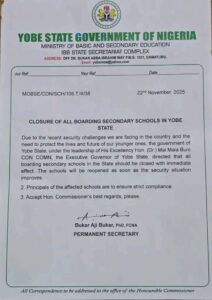
The directive was announced on Saturday by Governor Mai Mala Buni after an emergency security meeting with heads of state security agencies. The decision, confirmed by the Director General of Press and Media Affairs, Mohammed Mamman, signals a shift to a precautionary stance, prioritizing student safety above all else.
“A notice signed by the Permanent Secretary, Ministry of Basic and Secondary Education, Dr. Bukar Aji Bukar, directed the immediate closure of all secondary schools pending improvement in the situation,” the official statement read. This action places Yobe in the company of several other northern states that have recently taken similar measures.
The Context: A Wave of School Abductions
This policy is not an isolated event but a reaction to a clear and present danger. The governor’s order comes against a backdrop of recent, brazen attacks on educational institutions in the region.
Just days before the announcement, armed groups abducted several students from St. Mary’s School in Papiri, Agwara Local Government Area. This incident followed another attack in Maga, where 25 students were taken, creating a palpable sense of urgency and fear among communities and policymakers alike.
Analysis: The Broader Implications for Education and Security
The closure of boarding schools represents a significant disruption to the educational framework in Northern Nigeria. While a necessary short-term safety measure, it raises profound questions about the long-term strategy for securing learning environments.
This pattern of targeting schools not only jeopardizes the immediate safety of children but also threatens to reverse gains in school enrollment, particularly for girls, and undermines the fundamental right to education. The state’s action, while protective, underscores a critical failure to contain a security threat that is now directly impacting human capital development.
A Call for Collective Action
Beyond the administrative order, Governor Buni’s statement included an appeal for public support. He called on residents to bolster security efforts through prayer for the nation’s leadership and operatives on the front lines.
This dual approach—implementing concrete policy while seeking communal solidarity—highlights the complex nature of the crisis, where state capacity is being tested and the role of civil society is increasingly vital.
This report is based on information originally published by Neptune Prime.