











NNPC’s N12 Trillion Remittance Signals Fiscal Shift as Gas Infrastructure Nears Completion
Analysis of the state oil firm’s latest performance report reveals a company in transition, balancing its role as a cash cow for the government with ambitious commercial and infrastructural goals.
Primary Source: This report is based on information first published by Legit.ng.
Source: UGC
A Fiscal Lifeline Amid Economic Reforms
The Nigerian National Petroleum Company (NNPC) Limited has transferred a staggering N12.117 trillion to the national treasury in the first ten months of 2025, according to its November performance report. This remittance underscores the corporation’s enduring, critical function as the federal government’s primary revenue engine. The timing is significant, occurring against a backdrop of ambitious but challenging economic reforms aimed at weaning the state off oil dependency. The NNPC’s cash infusion provides essential fiscal breathing room, helping to stabilize government finances during this transitional period.
Commercial Performance Shows Marked Improvement
Beyond its statutory obligations, the report indicates a strengthening commercial entity. NNPC posted a group revenue of N4.358 trillion and a profit after tax of N502 billion. Analysts view this profitability as a tangible outcome of the company’s formal commercialization in 2021. The results suggest improved cost management and operational efficiency, even as the upstream sector grapples with persistent challenges like pipeline vandalism and aging infrastructure. This dual identity—as both a sovereign revenue collector and a profit-seeking commercial venture—is at the heart of NNPC’s ongoing transformation.
Production Stability and the Uptick Challenge
Oil and condensate production averaged 1.6 million barrels per day (mbpd) in November, a slight increase from October’s 1.58 mbpd. While the company reported 100% upstream pipeline availability—a notable achievement in Nigeria’s troubled oil sector—output remains below the 2025 peak of 1.77 mbpd. The modest fluctuations were attributed to planned maintenance on key assets, with full recovery anticipated by year’s end. The figures highlight a sector achieving stability but still struggling to consistently hit the higher production targets set by the government to meet OPEC quotas and boost export earnings.
Source: Getty Images
Gas Infrastructure: The Cornerstone of a New Strategy
The most forward-looking elements of the report concern Nigeria’s gas future. Two critical pipeline projects are nearing completion:
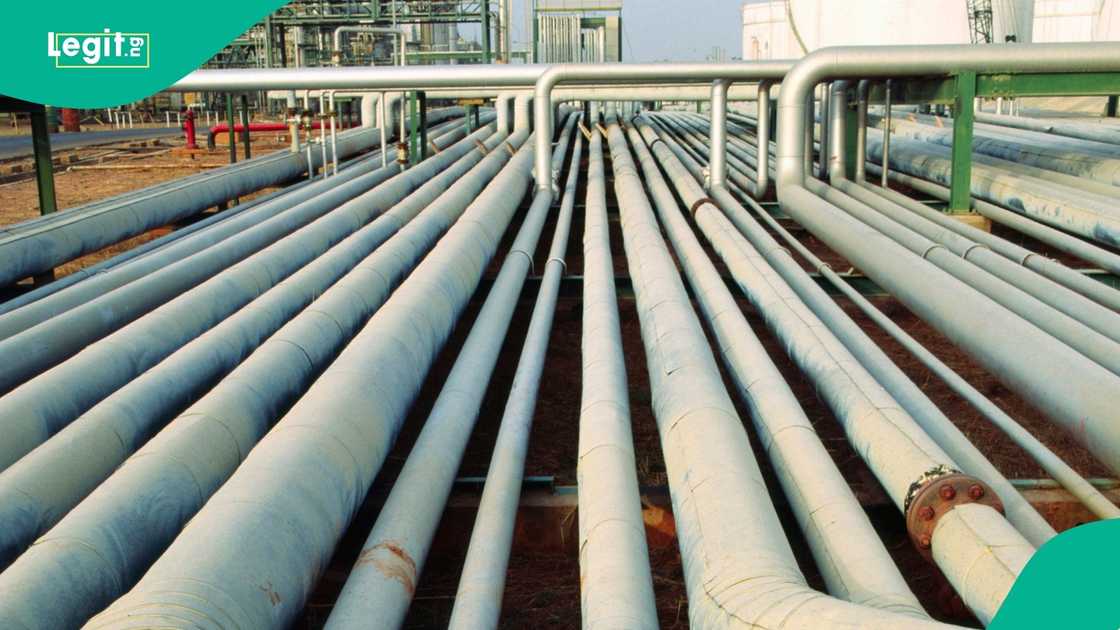
- The Ajaokuta–Kaduna–Kano (AKK) Pipeline is 90% complete, with mainline welding and pressure testing finished. Slated for completion in 2026, it is poised to unlock industrial and power generation potential in northern Nigeria, a region historically underserved by gas infrastructure.
- The Obiafu–Obrikom–Oben (OB3) Pipeline stands at 96% completion. The focus is now on the complex River Niger crossing. This pipeline is designed to enhance supply to both domestic markets and export terminals, crucial for leveraging Nigeria’s vast gas reserves.
These projects are central to the national “Decade of Gas” initiative. By improving transportation for the current production of nearly 7 billion cubic feet per day, they aim to reduce flaring, fuel power plants, and attract gas-based industries.
Strategic Divestment and the Path Forward
The reported financial health and project progress occur alongside another strategic move: NNPC’s launch of a bidding process to sell stakes in selected oil and gas assets. This divestment drive is not merely a revenue-raising exercise but a deliberate recalibration of the company’s portfolio. The goal is to shed non-core assets, attract fresh capital and expertise, and sharpen focus on major projects like the AKK and OB3 pipelines. This trifecta—strong remittances, improved profitability, and strategic infrastructure investment—paints a picture of a national oil company cautiously navigating its path toward becoming a globally competitive energy conglomerate.
Bottom Line: NNPC’s latest report reveals an institution at a crossroads. It continues to fulfill its traditional, vital role of funding the state, evidenced by the N12 trillion remittance. Simultaneously, its commercial profits and advancing gas mega-projects signal a deliberate, if gradual, pivot towards a future where it is not just a revenue conduit but a driver of energy development and economic diversification.