










Nigeria’s $300 Million Displacement Economy: A Missed Investment Frontier for West Africa
The Report
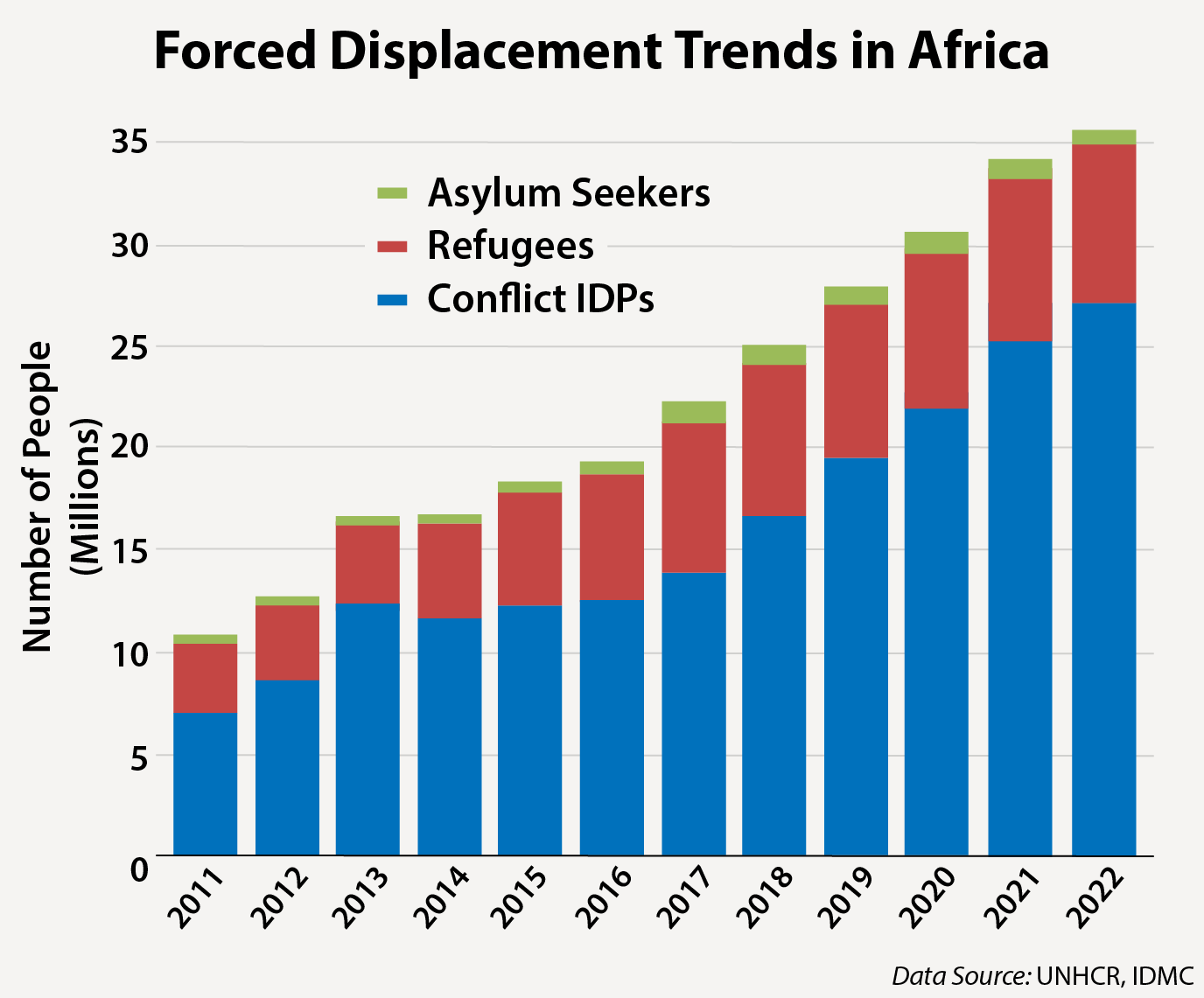
As reported by the Amahoro Coalition in its report Hiding in Plain Sight, Africa’s 43.1 million displaced population generates an estimated $27 billion in annual income, positioning it as one of the continent’s largest untapped investment markets. The report, launched in Abuja on Thursday, argues that displaced Africans—more than 56% of whom are economically active—should be viewed as an economy rather than a humanitarian crisis. It highlights that displaced entrepreneurs fail at only one-third the rate of businesses owned by host communities, challenging conventional risk assumptions.
Key findings include that fewer than 10 formal financial service providers currently serve about 27 million displaced people across Africa, compared to 852 banks competing for mainstream consumers. The report identifies agriculture, entrepreneurship, finance, manufacturing, and supply chains as sectors where commercial investment is lacking. Tito Mbathi, Strategy Custodian for Partnerships at Amahoro Coalition, stated that Nigeria’s displaced population alone generates an estimated $300 million annually.
“We do not want this conversation to focus only on aid. We want to have a commercial conversation. We want to discuss investment potential and explore how the private sector can address displacement through sustainable economic participation,” Mbathi said.
Nigeria is home to approximately 3.7 million internally displaced persons (IDPs), though estimates from the National Commission for Refugees, Migrants and Internally Displaced Persons suggest the figure could reach seven million. The report notes that giving displaced people across Africa access to productive assets such as land could unlock an estimated $2.4 billion agricultural opportunity, with northern Nigeria offering a particularly attractive entry point due to its combination of agricultural potential and high displacement concentrations.
Nigeria Time News Analysis
From a Nigerian policy perspective, the Amahoro Coalition’s findings reframe a long-standing humanitarian burden as a potential economic engine. For years, Nigeria’s IDP crisis—driven by Boko Haram insurgency in the Northeast, farmer-herder conflicts in the Middle Belt, and banditry in the Northwest—has been treated primarily as a drain on national resources. The report’s assertion that Nigeria’s displaced population generates $300 million annually suggests that with targeted investment, this figure could multiply significantly, potentially contributing to GDP growth and reducing dependency on foreign aid.
Looking at the broader ECOWAS implications, the report’s emphasis on agriculture as a $2.4 billion opportunity across Africa is particularly relevant for West Africa, where food insecurity and displacement are intertwined. Northern Nigeria, which hosts a large share of the region’s displaced farmers, could serve as a pilot zone for outgrower schemes and value-chain integration. If successful, such models could be replicated in other ECOWAS states facing similar challenges, such as the Lake Chad Basin region (affecting Niger, Chad, and Cameroon) or areas impacted by jihadist violence in Burkina Faso and Mali. The report’s finding that displaced entrepreneurs fail at lower rates than host-community businesses challenges the perception of IDPs as high-risk investments, potentially opening doors for regional development banks and private equity firms.
For the Nigerian diaspora, this report signals a new avenue for impact investment. Diaspora remittances to Nigeria exceeded $20 billion in 2023, but much of this flows to consumption rather than productive assets. The Amahoro Coalition’s framework—focusing on commercially sustainable integration rather than charity—could appeal to diaspora investors seeking both financial returns and social impact. Sectors like digital skills training, renewable energy, and agricultural extension services, as highlighted by Frederick Degbe, Amahoro Coalition’s Lead for Private Sector Partnerships in West Africa, offer tangible entry points. The report’s emphasis on leveraging existing infrastructure rather than building new ecosystems reduces barriers to entry for diaspora-backed ventures.
From a governance standpoint, the report implicitly critiques the Nigerian government’s approach to displacement. Despite the National Commission for Refugees, Migrants and Internally Displaced Persons estimating up to seven million IDPs, formal financial inclusion remains negligible. The report notes that fewer than 10 financial service providers serve 27 million displaced Africans, a gap that underscores the failure of both public policy and private sector outreach. The success of the Benue State livelihood restoration programme, cited by AgroLog Ltd Chairman Manzo Maigari, where 5,000 IDP families earned up to N2 million each within 12 months through piglet distribution and extension services, demonstrates that scalable models exist but remain underfunded and underreplicated.
Regional Context
Historically, Africa’s displacement crises have been framed through a humanitarian lens, with international donors and NGOs providing relief while private sector engagement remained minimal. The Amahoro Coalition’s report marks a paradigm shift, aligning with broader trends in development economics that advocate for market-based solutions to complex challenges. In West Africa, where displacement is often linked to climate change, resource scarcity, and insurgency, the report’s findings are timely. The Lake Chad Basin, for instance, has seen over 3 million people displaced due to Boko Haram violence, yet agricultural potential in the region remains largely untapped. The report’s call for integrating displaced farmers into formal value chains could address both economic stagnation and food security concerns across the Sahel. However, the report’s optimism must be tempered by the reality that insecurity remains a major barrier—as noted by Kabiru Ibrahim, former President of the All Farmers Association of Nigeria, who acknowledged initial scepticism about viewing displacement through an economic lens. Without sustained security improvements, particularly in northern Nigeria, private sector investment will remain cautious.
Original Reporting By:
Amahoro Coalition