










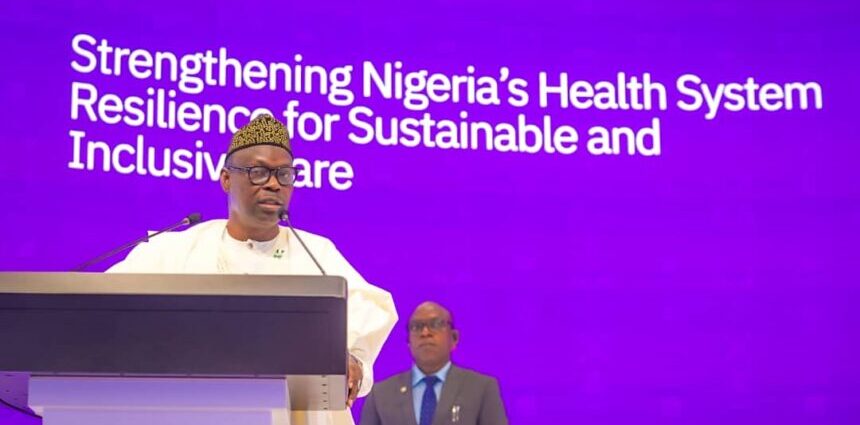
Nigeria Vows to Build Resilient, Inclusive Health System Amid Funding and Access Challenges
The Federal Government has reaffirmed its commitment to forging a robust and inclusive health system capable of withstanding future shocks, with plans centered on increased funding, wider insurance coverage, and a deeper embrace of digital technology.
Dr. Iziaq Adekunle Salako, the Minister of State for Health and Social Welfare, outlined this ambitious vision during the second day of the 2025 Joint Annual Review Meeting (JAR) in Abuja. He stated the administration is dedicated to constructing a health system that genuinely serves every Nigerian, aligning with President Bola Ahmed Tinubu’s Renewed Hope Agenda.
Learning from Global Crises
“The last half-decade has tested health systems globally in unprecedented ways,” Dr. Salako reflected. “From the COVID-19 pandemic to sharp reductions in international donor assistance, these incidents exposed deep-seated vulnerabilities. Yet, they also proved the undeniable power of coordinated action, innovation, and unwavering political commitment.”
He pointed to modest but encouraging improvements in the nation’s key health indicators, citing preliminary data from the 2023 Nigeria Demographic and Health Survey.
Progress Amid Persistent Hurdles
The data reveals a decline in maternal mortality to 512 deaths per 100,000 live births, down from 576 in 2018. Similarly, under-five mortality has fallen to 110 deaths per 1,000 live births from 132. Other gains include a rise in skilled birth attendance from 43% to 53%, and an increase in full childhood immunization coverage to 39%, up from 31%.
Despite these positive trends, the Minister delivered a stark assessment of the financial underpinnings of the sector. He described Nigeria’s healthcare investment as “grossly inadequate,” noting that government health expenditure constitutes a mere 5.2% of GDP—far below the 15% benchmark pledged in the Abuja Declaration.
“Per capita health expenditure is just about $43, and out-of-pocket spending still stands at a staggering 71%,” Salako lamented. “This is unacceptable, as it continues to push millions of Nigerians into poverty every single year.”
The Roadmap to Resilience
At the heart of the government’s strategy is the Nigerian Health Sector Renewal Investment Initiative (NHSRII), which operates through a Sector-Wide Approach (SWAp). A cornerstone of this initiative is the Basic Health Care Provision Fund (BHCPF), a major domestic investment in primary healthcare. The fund’s absorption capacity has seen a significant jump, rising from 45% in 2019 to 78% in 2023.
On the critical front of health insurance, the Minister reported substantial progress. “Through the BHCPF and the National Health Insurance Authority Act of 2024, over 20 million Nigerians have now been enrolled into insurance-based care,” he said. “The recent executive order mandating health insurance across all Ministries, Departments, and Agencies will accelerate us past our 2027 coverage target.”
Tangible Gains in Disease Control and Workforce
Dr. Salako provided concrete updates on the fight against major diseases:
HIV: Nigeria now has 1.78 million people living with HIV on treatment, achieving 80% antiretroviral therapy coverage and 96% coverage for the prevention of mother-to-child transmission.
Malaria: A massive distribution of over 63 million insecticide-treated nets between 2021 and 2023 has led to 70% of households owning at least one net, averting an estimated 18 million malaria cases annually.
Immunization: The country has maintained zero wild poliovirus cases since 2020 and has successfully introduced new vaccines for HPV and measles-rubella.
Addressing the critical issue of healthcare worker migration, often referred to as “Japa,” the Minister announced the employment of over 37,000 health workers between 2023 and 2025. A new Health Workforce Migration Policy aims to curb this brain drain.
“We are converting brain drain into brain gain,” Salako declared to applause. “Our new diaspora engagement strategy aims to turn ‘Japa’ into ‘Japada’ (meaning ‘come back’).”
Digital Highways and Power for Health
The government is also pushing a digital transformation agenda through the Nigeria Digital Health Initiative (NDHI), which has established a National Digital Health Architecture. “We are ending the era of data fragmentation and ensuring that digital highways connect every part of our health system,” the Minister asserted.
On infrastructure, he noted the completion of more than 500 high-impact health projects nationwide, complemented by the Power for Health Initiative designed to provide reliable electricity to hospitals and clinics.
Acknowledging the Road Ahead
While celebrating these achievements, Dr. Salako did not shy away from the significant challenges that remain, including persistent funding gaps, human resource shortages, and stark inequities in healthcare access between urban and rural populations.
“We refuse to be defined by our challenges. We are determined to change the narrative once and for all,” he stated resolutely.
Looking forward, the government’s next steps involve comprehensive health financing reform, strict enforcement of mandatory insurance, a massive expansion of primary health centres, and strategic investments in climate-resilient and green energy systems for health facilities.
“Without commodity security, there can be no health security,” Salako stressed, pledging to create transparent and fully digitalized supply chain systems.
He concluded with a powerful call to action, urging all stakeholders to collaborate. “The resilient health system we seek is one where every Nigerian, regardless of income or location, can access care without financial hardship,” he declared. “Only healthy people can build a prosperous nation.”
Source: Nigerian Tribune